
“Big boys don’t cry.”
Those are the first four words of my newest novel, “Twice in Love With Amy,” which should be available on Amazon before the end of the year.
“That’s the first advice I ever remember getting. I think I was 4 years old and sitting in a barber’s chair in Crestline, Ohio, my mother’s hometown. My grandfather had taken me to get a haircut – something akin to a sheep shearing in those days – and the barber’s weapon of mass destruction had nicked my ear.”
That’s just a taste to whet your appetite, but that’s not what today’s post is about.
The subject is crying.
Those of us who came of age in the baby boom years were raised to listen to our parents, to eat everything on our plates at the dinner table and never never never to cry.

Anyone who wasn’t bleeding to death or getting their genitals caught in a meat grinder and was crying had to worry about other male relatives and acquaintances wondering if the weeper was a sissy … or even worse, a homosexual.
That left people of the masculine persuasion sucking it up and keeping a stiff upper lip in some very difficult situations. When my son Virgile was 9 years old and playing youth soccer, he was defending down in a corner near the goal. An attacker kicked a ball that hit him directly into his gut.
He stayed with it, and the ball bounced back to the attacker, who kicked it again into my son’s midsection. He had been trying to catch his breath and now he could barely inhale. Somehow this time he was able to control the ball and kick it out of bounds to stop play.
Then he fell to the ground gasping and started crying a little.
Anything but a sissy. He was one tough kid.
Of course that was 1994 and “big boys don’t cry” was no longer a trope of masculinity. It had fallen into disrepair just like cleaning your plate because children were starving in Europe.
One of the things that changed all that for American men was a 1971 television movie called “Brian’s Song.” It was the story of two Chicago Bears teammates — one white, one black — who became friends. Gale Sayers was an amazing running back who wound up in the Pro Football Hall of Fame. Brian Piccolo was a lesser back but still a good one who died of cancer at age 26.
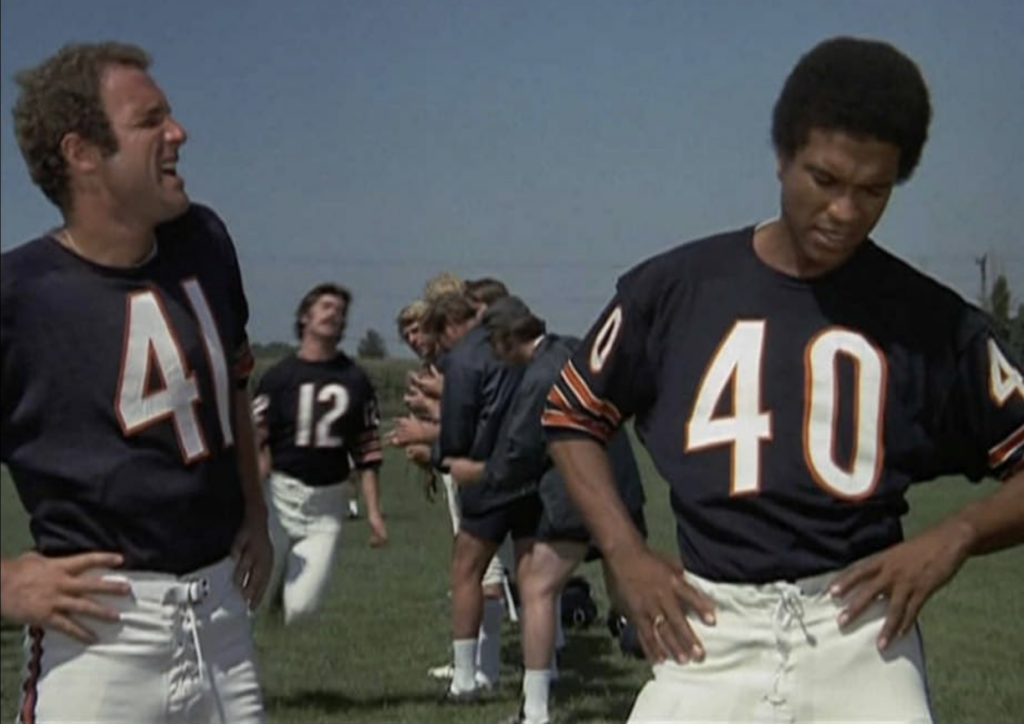
At the end, actor Jack Warden playing Coach George Halas delivers what is essentially an obituary.
“Brian Piccolo died of cancer at the age of 26. He left a wife and three daughters. He also left a great many loving friends who miss him and think of him often. But when they think of him, it’s not how he died that they remember, but rather how he lived. How he did live!”
James Caan as Piccolo and Billy Dee Williams as Sayers both went on to become big stars, Caan in “The Godfather” and Williams in the “Star Wars” movies and other films. Both were superb in “Brian’s Song.”
You would be surprised to realize what a big deal it was in 1971 for all sorts of American men to admit that the end of “Brian’s Song” left them weeping like little girls. They weren’t homosexuals or even sissies, just human beings displaying human emotions.
After all, it ought tp be obvious.
“Big boys do cry.”